
BBP-765 765 nm bandpass filter
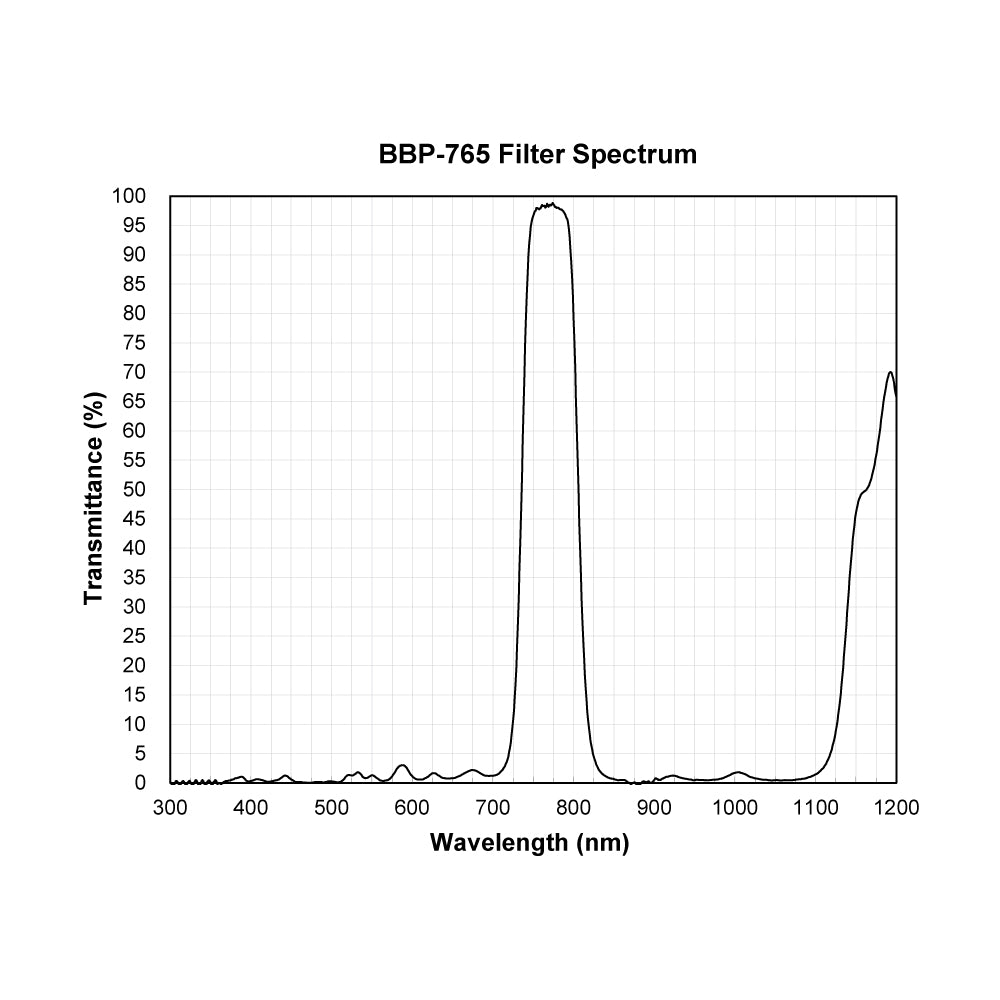
BBP-765 is a bandpass filter. The main high-transmission region is approximately 742-799 nm.
- Measured wavelength range: 300-1200 nm
- Main-band width: ≈ 70.6 nm at half-peak transmission
- Peak transmission: ≈ 98.9% at 774 nm
- Transmission ≥80%: 742-799 nm
- Transmission ≤5%: 300-719 nm; 825-1118 nm
- Custom options: Wavelength response, dimensions and operating conditions
Values shown are sample measurements. Final specifications are agreed for your order.

BBP-765 765 nm bandpass filter
BBP-765 is a bandpass filter. The main high-transmission region is approximately 742-799 nm.
- Measured wavelength range: 300-1200 nm
- Main-band width: ≈ 70.6 nm at half-peak transmission
- Peak transmission: ≈ 98.9% at 774 nm
- Transmission ≥80%: 742-799 nm
- Transmission ≤5%: 300-719 nm; 825-1118 nm
- Custom options: Wavelength response, dimensions and operating conditions
Values shown are sample measurements. Final specifications are agreed for your order.
765 nm nominal-channel bandpass filter (BBP-765)
BBP-765 is a bandpass filter. The main high-transmission region is approximately 742-799 nm. Use the full curve to match the desired signal and check secondary transmission before choosing the filter.
Optical performance
- Measured wavelength range: 300-1200 nm. Performance outside this measured interval is not established by this curve.
- Main band at half-peak transmission: Approximately 735.5-806.1 nm, giving a full width at half maximum (FWHM) of approximately 70.6 nm. This describes the main band only; other transmitted regions may remain.
- Selected regions at or above 80% transmission: 742-799 nm. Approximate measured intervals.
- Selected regions at or below 5% transmission: 300-719 nm; 825-1118 nm. Measured sample intervals; confirm the required blocking for your order.
- Peak transmission: Approximately 98.9% at 774 nm. Peak wavelength is not the same as a defined centre wavelength.
- Average measured transmission, 300-700 nm: 0.753%. Calculated from the factory sample data.
- Average measured transmission, 745-780 nm: 97.611%. Calculated from the factory sample data.
- Average measured transmission, 830-1100 nm: 0.729%. Calculated from the factory sample data.
- Customization: We can customize stock and sample-book designs. Tell us the wavelength response, size and operating conditions you need.
These values come from the measured samples and help you choose a starting design. We will agree the final specification for your order. Custom versions have their own specifications and measured curves.
Applications to consider
- 780 nm illuminated inspection: Consider a source around 780 nm. Match the full source bandwidth to the curve, and check ambient-light rejection over the detector response.
- Optical sensing channels: Evaluate the transmitted region for a source-and-detector pair. Secondary transmitted light may require additional blocking or a detector with a limited response.
- Fluorescence instrument development: Consider the profile for an excitation or collection channel after matching both spectra. Confirm rejection of the excitation line and other transmitted bands in the complete optical layout.
Choosing this filter
- Additional regions reach at least 50% transmission at approximately 1164-1200 nm. Include these in the detector and blocking assessment.
- Check the full wavelength range of your light source, the wavelengths your detector responds to, and how much unwanted light you need to block. Use the full curve when choosing a filter; the product code and peak do not tell the whole story.
- Tell us the angle at which light reaches the filter and whether the beam is parallel or converging. For demanding rejection or high-power use, confirm the required blocking and power-handling specifications.
Custom options
Start with this stock or sample-book design, then tell us what you need to change. We can discuss the wavelength bands, transmission, blocking, angle, glass material, size and operating conditions with you, and agree a specification for your custom filter.
Catalog cross-reference: BP765-D01; earlier reference BBP-765. Include either reference in your inquiry.
Transmission spectrum
Questions about BBP-765
Which part of the spectrum is most useful when choosing BBP-765?
The measured regions at or above 80% transmission are 742-799 nm. They are measured intervals, not guaranteed passband tolerances. Compare the full curve with the signal wavelengths you need to retain.
What should I check beyond the main transmission region of BBP-765?
For BBP-765, additional regions reach at least 50% transmission at approximately 1164-1200 nm. If your detector responds there, include that light in the background assessment or discuss an additional blocking requirement.
Discuss this filter with KUPO - include the product reference, source wavelength, working angle and required dimensions.