
BMS-001 Beam splitter
BMS-001 is a beam splitter. Consider it when you need to split light between a main optical path and a monitoring detector or second device.
- Measured wavelength range: 300-800 nm
- Factory angle: 45°; confirm for your configuration
- 400-700 nm: 83.062% average transmission
- Custom options: Wavelength response, dimensions and operating conditions
Values shown are sample measurements. Final specifications are agreed for your order.

BMS-001 Beam splitter
BMS-001 is a beam splitter. Consider it when you need to split light between a main optical path and a monitoring detector or second device.
- Measured wavelength range: 300-800 nm
- Factory angle: 45°; confirm for your configuration
- 400-700 nm: 83.062% average transmission
- Custom options: Wavelength response, dimensions and operating conditions
Values shown are sample measurements. Final specifications are agreed for your order.
Beam splitter (BMS-001)
BMS-001 is a beam splitter. Consider it when you need to split light between a main optical path and a monitoring detector or second device. The reference spectrum describes the transmitted path; choose the required reflection ratio and angle of incidence with KUPO.
Optical performance
- Measured wavelength range: 300-800 nm. Performance outside this measured interval is not established by this curve.
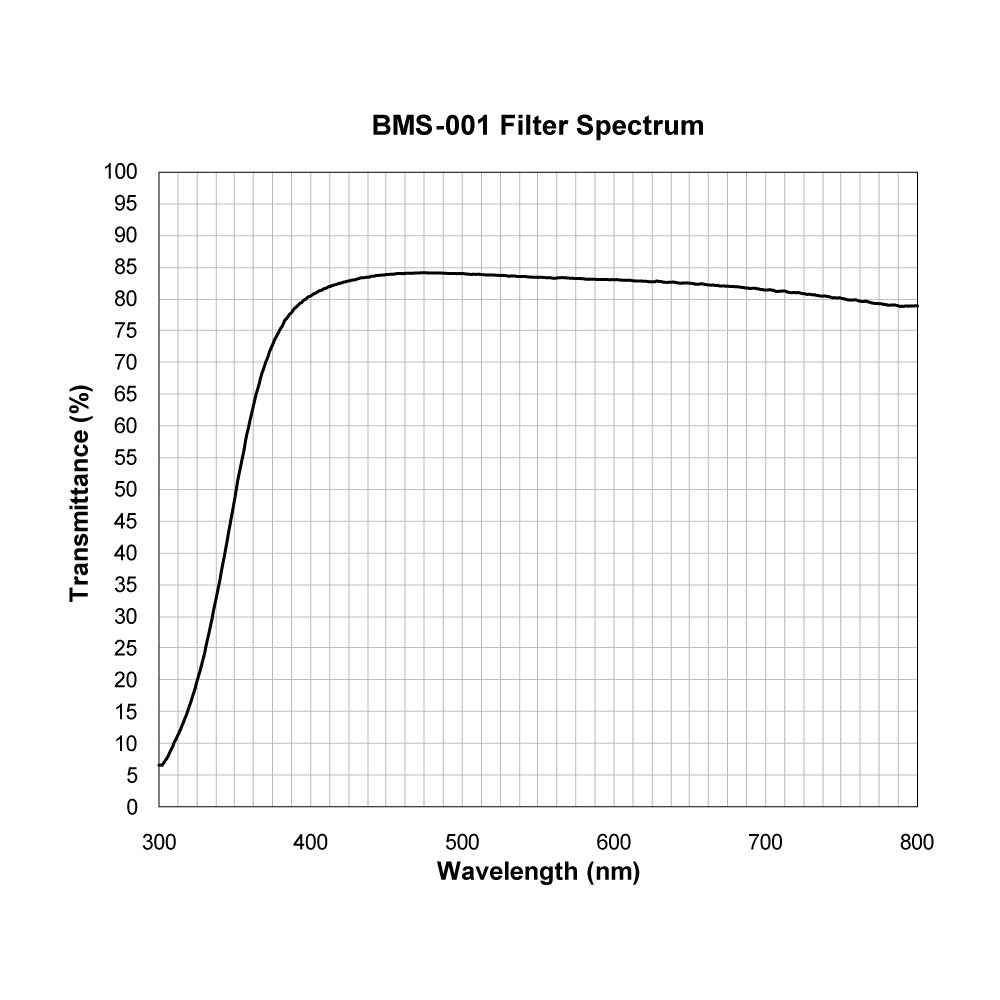
- 400-500 nm: Approximately 80.5-84.2% transmission in the measured curve.
- 500-600 nm: Approximately 83-84% transmission in the measured curve.
- 600-700 nm: Approximately 81.4-83.1% transmission in the measured curve.
- Reflection and working angle: Specify the required reflected path, polarization and angle; transmission alone does not establish those properties.
- Average measured transmission, 400-700 nm: 83.062%. Calculated from the factory sample data.
- Factory working-angle designation: The matching factory worksheet is designated for 45 degrees angle of incidence. Confirm polarization and final acceptance conditions for the supplied configuration.
- Customization: We can customize stock and sample-book designs. Tell us the wavelength response, size and operating conditions you need.
These values come from the measured samples and help you choose a starting design. We will agree the final specification for your order. Custom versions have their own specifications and measured curves.
Applications to consider
- Illumination monitoring: Consider it for sending part of a beam to a monitoring detector. Specify the required throughput in both paths at the working angle.
- Dual-path imaging: Consider it for sharing light between a camera and another imaging or viewing device. Account for polarization, wavefront requirements and wavelength-dependent balance.
- Instrument integration: Compare the transmission profile with the required spectral band, then confirm reflection and geometry before finalizing the optical layout.
Choosing this filter
- Confirm transmitted and reflected specifications separately, including polarization and angle of incidence. The supplied transmission curve is not a measurement of the reflected path.
Custom options
Start with this stock or sample-book design, then tell us what you need to change. We can discuss the wavelength bands, transmission, blocking, angle, glass material, size and operating conditions with you, and agree a specification for your custom filter.
Transmission spectrum
Questions about BMS-001
What does the BMS-001 curve tell me about the two output paths?
It gives the transmitted-light response, including 83.062% average transmission over 400-700 nm. It does not independently measure the reflected path. Specify the response you need in each path rather than assuming they are equal.
Can I choose BMS-001 before fixing the beam geometry?
The matching factory worksheet is designated for 45-degree incidence. For BMS-001, include the wavelength range and polarization of each path. A transmission curve alone is not enough to establish the split for a different geometry.
Discuss this filter with KUPO - include the product reference, source wavelength, working angle and required dimensions.