
CTO-009 Warming color-correction filter
CTO-009 is a warming color-correction filter that reduces blue-to-green light relative to longer visible wavelengths. Use it to adjust a broadband source’s color balance; the final effect depends on the lamp spectrum.
- Measured wavelength range: 380-780 nm
- 400-500 nm: 61.3% average transmission
- 500-600 nm: 70.7% average transmission
- 600-700 nm: 83.4% average transmission
- Custom options: Wavelength response, dimensions and operating conditions
Values shown are sample measurements. Final specifications are agreed for your order.

CTO-009 Warming color-correction filter
CTO-009 is a warming color-correction filter that reduces blue-to-green light relative to longer visible wavelengths. Use it to adjust a broadband source’s color balance; the final effect depends on the lamp spectrum.
- Measured wavelength range: 380-780 nm
- 400-500 nm: 61.3% average transmission
- 500-600 nm: 70.7% average transmission
- 600-700 nm: 83.4% average transmission
- Custom options: Wavelength response, dimensions and operating conditions
Values shown are sample measurements. Final specifications are agreed for your order.
Warming color-correction filter (CTO-009)
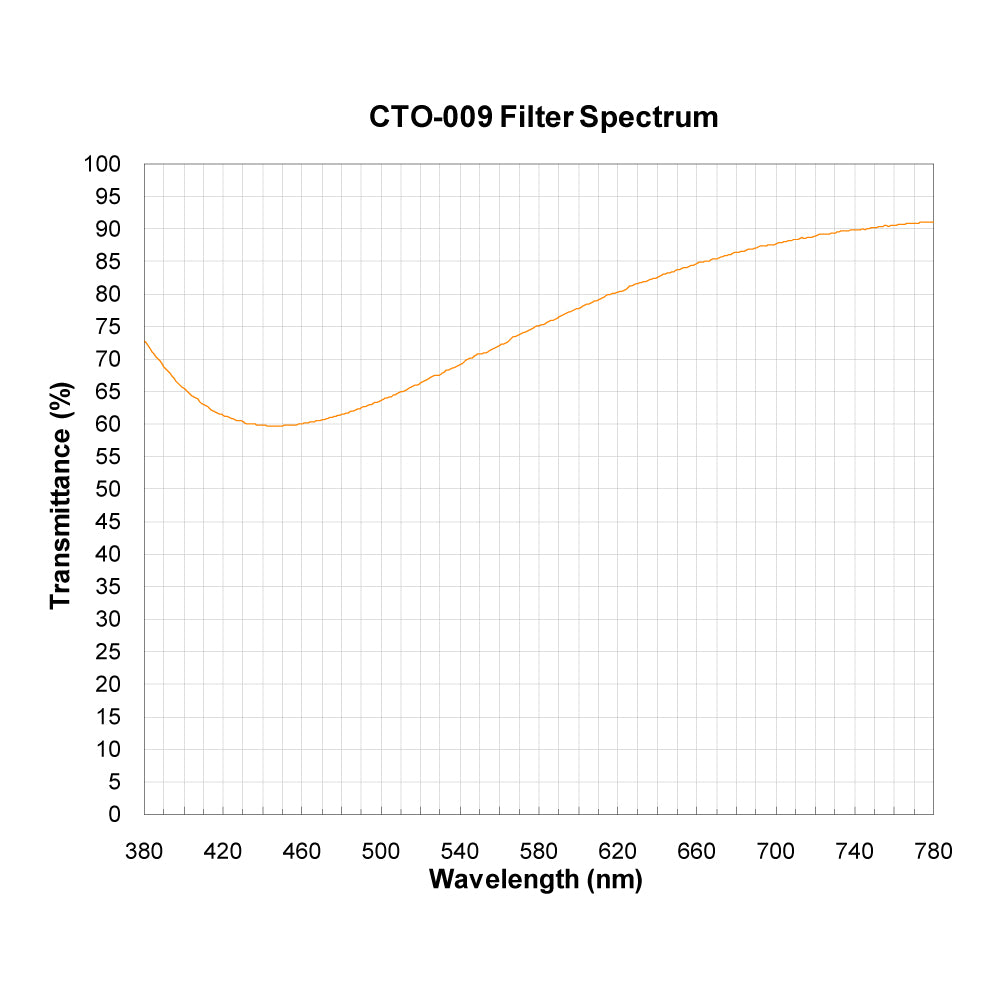
CTO-009 is a warming color-correction filter. It reduces blue-to-green light relative to longer visible wavelengths. This can give a suitable broadband light source a warmer balance. Average transmission in the sample is 61.3% over 400-500 nm, 70.7% over 500-600 nm, 83.4% over 600-700 nm. The resulting light output also depends on the lamp spectrum.
Optical performance
- Measured wavelength range: 380-780 nm. Performance outside this measured interval is not established by this curve.
- 400-500 nm: Approximately 61.3% average transmission; the range is 59.7-65.4% in the measured curve.
- 500-600 nm: Approximately 70.7% average transmission; the range is 63.6-77.8% in the measured curve.
- 600-700 nm: Approximately 83.4% average transmission; the range is 77.8-87.7% in the measured curve.
- Customization: We can customize stock and sample-book designs. Tell us the wavelength response, size and operating conditions you need.
These values come from the measured samples and help you choose a starting design. We will agree the final specification for your order. Custom versions have their own specifications and measured curves.
Applications to consider
- Stage and architectural lighting: Try it when you need a warmer balance from a broadband white light source. Check the color and brightness with your actual light source before choosing a filter.
- Film and photographic lighting: Consider it for warming a daylight or cool-white fixture toward another light in the scene. Measure the color match with the actual fixtures and camera.
- Fixture development: Use the measured color-shaping profile to compare available coatings. Confirm the required color temperature, tint, throughput and operating conditions on the assembled fixture.
Choosing this filter
- Evaluate the filter together with the intended light source. Color temperature, tint, color rendering and luminous output depend on that combination.
- Tell us the size, shape and working angle you need, along with the temperature conditions inside the fixture.
Custom options
Start with this stock or sample-book design, then tell us what you need to change. We can discuss the wavelength bands, transmission, blocking, angle, glass material, size and operating conditions with you, and agree a specification for your custom filter.
Transmission spectrum
Questions about CTO-009
What do the measured values tell me about CTO-009 on white light?
The sample averages are 61.3% over 400-500 nm; 70.7% over 500-600 nm; 83.4% over 600-700 nm. Compare those bands rather than treating the filter as a uniform dimmer: the relative transmission is what changes the light balance.
Can I predict the brightness after CTO-009 from these three averages?
The 61.3% average over 400-500 nm gives each measured wavelength equal weight; an LED may concentrate its output in a narrow peak within that interval. Look up your actual emission wavelengths on the CTO-009 curve, or evaluate a sample with your source and detector.
Discuss this filter with KUPO - include the product reference, source wavelength, working angle and required dimensions.