
HM-735 Visible-pass / infrared-attenuating filter
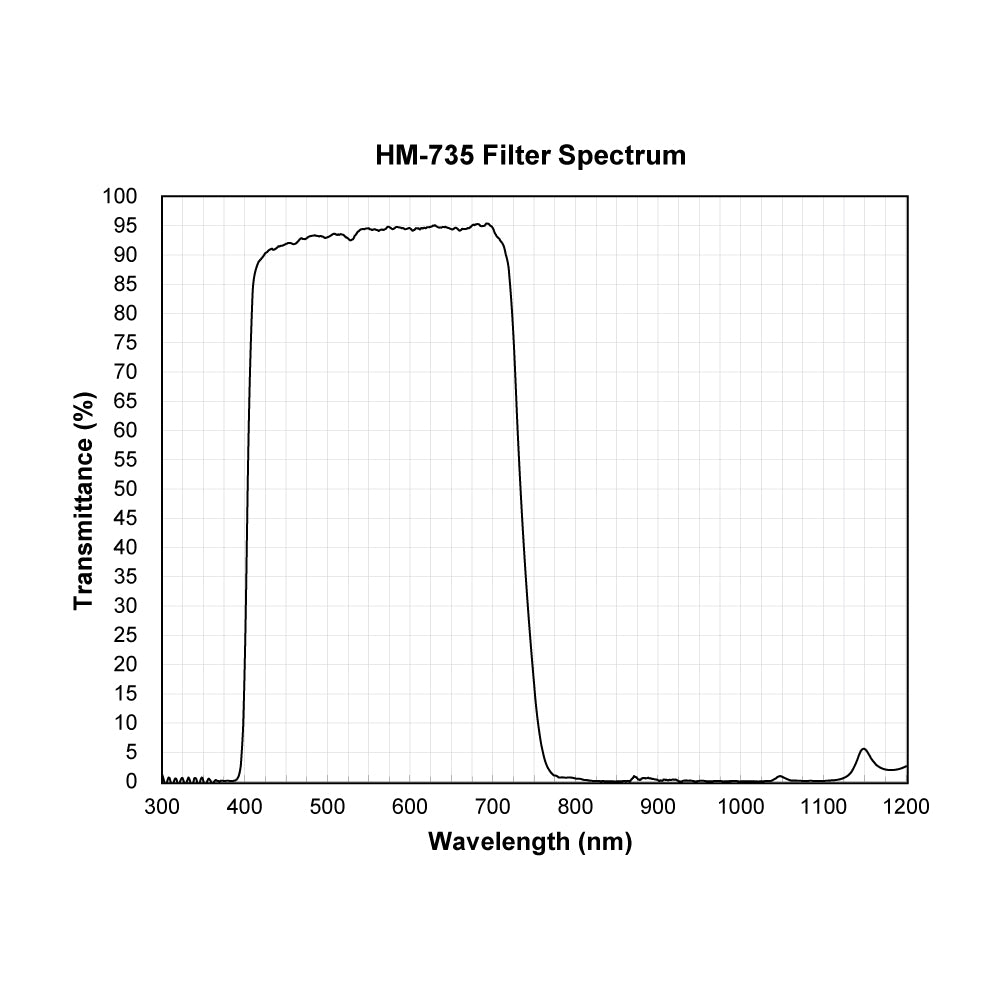
HM-735 is a visible-pass / infrared-attenuating filter. The main high-transmission region is approximately 409-723 nm.
- Measured wavelength range: 300-1200 nm
- Edge at 50% transmission: ≈ 733.6 nm
- Peak transmission: ≈ 95.4% at 693 nm
- Transmission ≥80%: 409-723 nm
- Transmission ≤5%: 300-396 nm; 761-1144 nm; 1154-1200 nm
- Custom options: Wavelength response, dimensions and operating conditions
Values shown are sample measurements. Final specifications are agreed for your order.

HM-735 Visible-pass / infrared-attenuating filter
HM-735 is a visible-pass / infrared-attenuating filter. The main high-transmission region is approximately 409-723 nm.
- Measured wavelength range: 300-1200 nm
- Edge at 50% transmission: ≈ 733.6 nm
- Peak transmission: ≈ 95.4% at 693 nm
- Transmission ≥80%: 409-723 nm
- Transmission ≤5%: 300-396 nm; 761-1144 nm; 1154-1200 nm
- Custom options: Wavelength response, dimensions and operating conditions
Values shown are sample measurements. Final specifications are agreed for your order.
Visible-pass / infrared-attenuating filter (HM-735)
HM-735 is a visible-pass / infrared-attenuating filter. The main high-transmission region is approximately 409-723 nm. It can be considered when visible light is required and part of the longer-wavelength spectrum needs attenuation.
Optical performance
- Measured wavelength range: 300-1200 nm. Performance outside this measured interval is not established by this curve.
- Selected regions at or above 80% transmission: 409-723 nm. Approximate measured intervals.
- Selected regions at or below 5% transmission: 300-396 nm; 761-1144 nm; 1154-1200 nm. Measured sample intervals; confirm the required blocking for your order.
- Peak transmission: Approximately 95.4% at 693 nm. Peak wavelength is not the same as a defined centre wavelength.
- Average measured transmission, 425-680 nm: 93.688%. Calculated from the factory sample data.
- Average measured transmission, 800-1150 nm: 0.401%. Calculated from the factory sample data.
- Measured edge at 50% transmission: Approximately 733.6 nm. Interpolated absolute-transmission crossing, checked against the factory summary.
- Customization: We can customize stock and sample-book designs. Tell us the wavelength response, size and operating conditions you need.
These values come from the measured samples and help you choose a starting design. We will agree the final specification for your order. Custom versions have their own specifications and measured curves.
Applications to consider
- Visible-light camera systems: Evaluate attenuation of unwanted longer-wavelength light while retaining the visible signal. Check the entire detector sensitivity range, including any transmission recovery.
- Illumination optics: Consider spectral conditioning between a source and the illuminated object. Confirm the source-weighted transmitted power and how reflected or absorbed power is managed.
- Color-imaging development: Compare the visible response with the required camera color balance. Account for differences at the blue and red edges before choosing the optic.
Choosing this filter
- Check the full wavelength range of your light source, the wavelengths your detector responds to, and how much unwanted light you need to block. Use the full curve when choosing a filter; the product code and peak do not tell the whole story.
- Tell us the angle at which light reaches the filter and whether the beam is parallel or converging. For demanding rejection or high-power use, confirm the required blocking and power-handling specifications.
Custom options
Start with this stock or sample-book design, then tell us what you need to change. We can discuss the wavelength bands, transmission, blocking, angle, glass material, size and operating conditions with you, and agree a specification for your custom filter.
Transmission spectrum
Questions about HM-735
What high-transmission regions should I compare for HM-735?
The measured regions at or above 80% transmission are 409-723 nm. They are measured intervals, not guaranteed passband tolerances. Compare the full curve with the signal wavelengths you need to retain.
Can HM-735 be treated as a complete infrared blocker?
The supplied measurement extends over 300-1200 nm. Regions at or below 5% transmission are 300-396 nm; 761-1144 nm; 1154-1200 nm. Check the complete detector sensitivity range and specify the maximum leakage you can accept; behavior outside the measured interval is not established.
Discuss this filter with KUPO - include the product reference, source wavelength, working angle and required dimensions.