
LEE209 Neutral-density filter
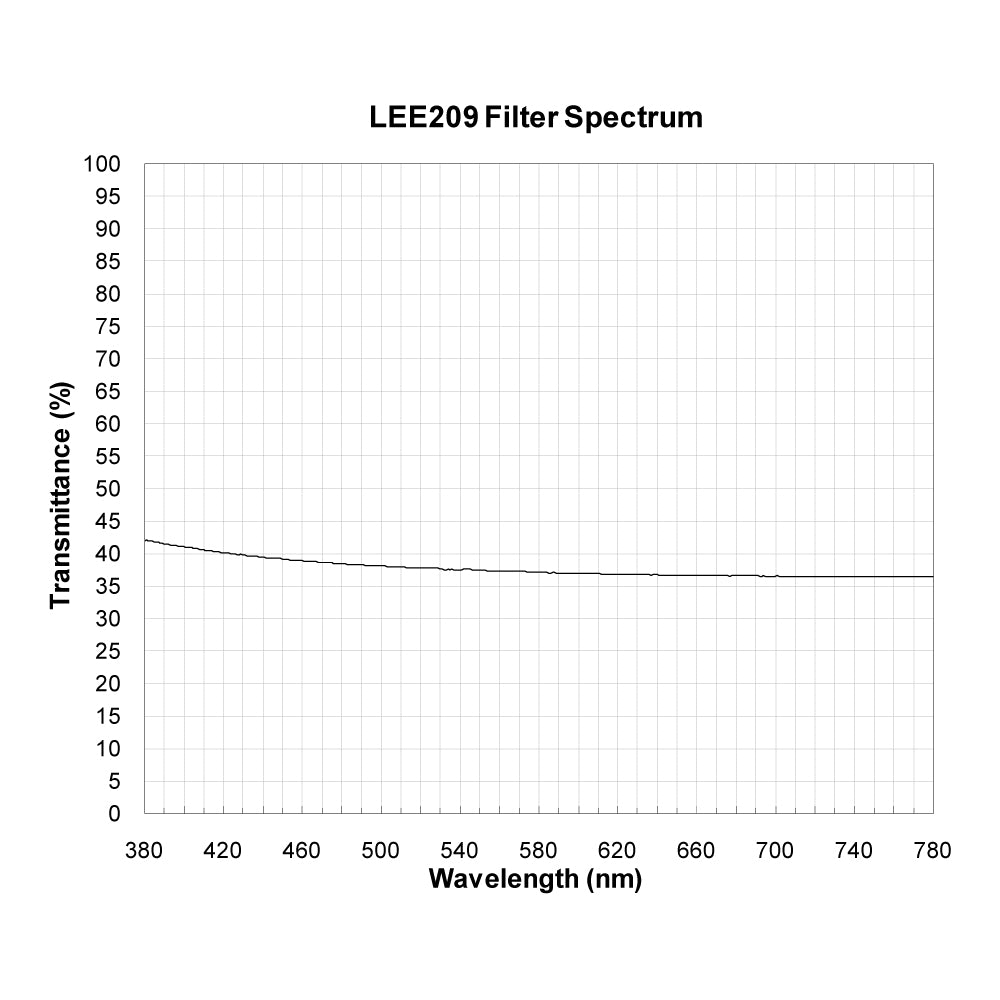
LEE209 is a neutral-density filter. The measured curve transmits approximately 36.5-41.1% over 400-700 nm.
- Measured wavelength range: 380-780 nm
- Optical density: ≈ 0.39-0.44 over 400-700 nm
- Exposure reduction: ≈ 1.28-1.45 stops over 400-700 nm
- Custom options: Wavelength response, dimensions and operating conditions
Values shown are sample measurements. Final specifications are agreed for your order.

LEE209 Neutral-density filter
LEE209 is a neutral-density filter. The measured curve transmits approximately 36.5-41.1% over 400-700 nm.
- Measured wavelength range: 380-780 nm
- Optical density: ≈ 0.39-0.44 over 400-700 nm
- Exposure reduction: ≈ 1.28-1.45 stops over 400-700 nm
- Custom options: Wavelength response, dimensions and operating conditions
Values shown are sample measurements. Final specifications are agreed for your order.
Neutral-density filter (LEE209)
LEE209 is a neutral-density filter. The measured curve transmits approximately 36.5-41.1% over 400-700 nm. It provides attenuation for exposure and detector-level adjustment; the variation across wavelength should be considered when color balance matters.
Optical performance
- Measured wavelength range: 380-780 nm. Performance outside this measured interval is not established by this curve.
- Measured optical density: Approximately 0.39-0.44 over 400-700 nm.
- Exposure reduction: Approximately 1.28-1.45 stops across the same interval. Actual exposure change depends on the source and detector response.
- Customization: We can customize stock and sample-book designs. Tell us the wavelength response, size and operating conditions you need.
These values come from the measured samples and help you choose a starting design. We will agree the final specification for your order. Custom versions have their own specifications and measured curves.
Applications to consider
- Imaging exposure control: Evaluate attenuation when the required shutter speed, aperture or illumination level leaves the detector close to saturation. Check color balance across the camera response.
- Lighting-level adjustment: Consider reducing output without changing the source drive setting. Choose attenuation and thermal conditions for your fixture.
- Optical test benches: Consider a transmission attenuator for detector-range adjustment. Confirm wavelength-dependent attenuation and power handling against the test setup.
Choosing this filter
- Match attenuation to the wavelength range of the source and detector. Optical density and exposure reduction vary with wavelength.
- For high-power light sources, tell us the power density at the filter, beam size and operating conditions so we can assess a suitable optic.
Custom options
Start with this stock or sample-book design, then tell us what you need to change. We can discuss the wavelength bands, transmission, blocking, angle, glass material, size and operating conditions with you, and agree a specification for your custom filter.
Transmission spectrum
Questions about LEE209
How much exposure reduction should I expect from LEE209?
The sample calculation gives approximately 1.28-1.45 stops over 400-700 nm. Its optical density is approximately 0.39-0.44 over 400-700 nm. These estimates help you choose attenuation; check the result with your actual source and detector.
Is LEE209 equally neutral across blue, green and red?
The measured transmission varies from 36.5-41.1% over 400-700 nm. That is the variation to assess when color balance matters. Compare the full visible curve with the wavelengths used by your source rather than treating the attenuation as perfectly flat.
Discuss this filter with KUPO - include the product reference, source wavelength, working angle and required dimensions.