
M12613 472-612 nm nominal rejection-region broadband notch filter
M12613 is a broadband notch filter. Its measured curve has a low-transmission region at approximately 490-594 nm, with transmission recovering on either side.
- Measured wavelength range: 380-780 nm
- Lower 50% edge: ≈ 472.1 nm
- Upper 50% edge: ≈ 611.7 nm
- Peak transmission: ≈ 95.5% at 682 nm
- Transmission ≥80%: 409-467 nm; 619-727 nm
- Custom options: Wavelength response, dimensions and operating conditions
Values shown are sample measurements. Final specifications are agreed for your order.

M12613 472-612 nm nominal rejection-region broadband notch filter
M12613 is a broadband notch filter. Its measured curve has a low-transmission region at approximately 490-594 nm, with transmission recovering on either side.
- Measured wavelength range: 380-780 nm
- Lower 50% edge: ≈ 472.1 nm
- Upper 50% edge: ≈ 611.7 nm
- Peak transmission: ≈ 95.5% at 682 nm
- Transmission ≥80%: 409-467 nm; 619-727 nm
- Custom options: Wavelength response, dimensions and operating conditions
Values shown are sample measurements. Final specifications are agreed for your order.
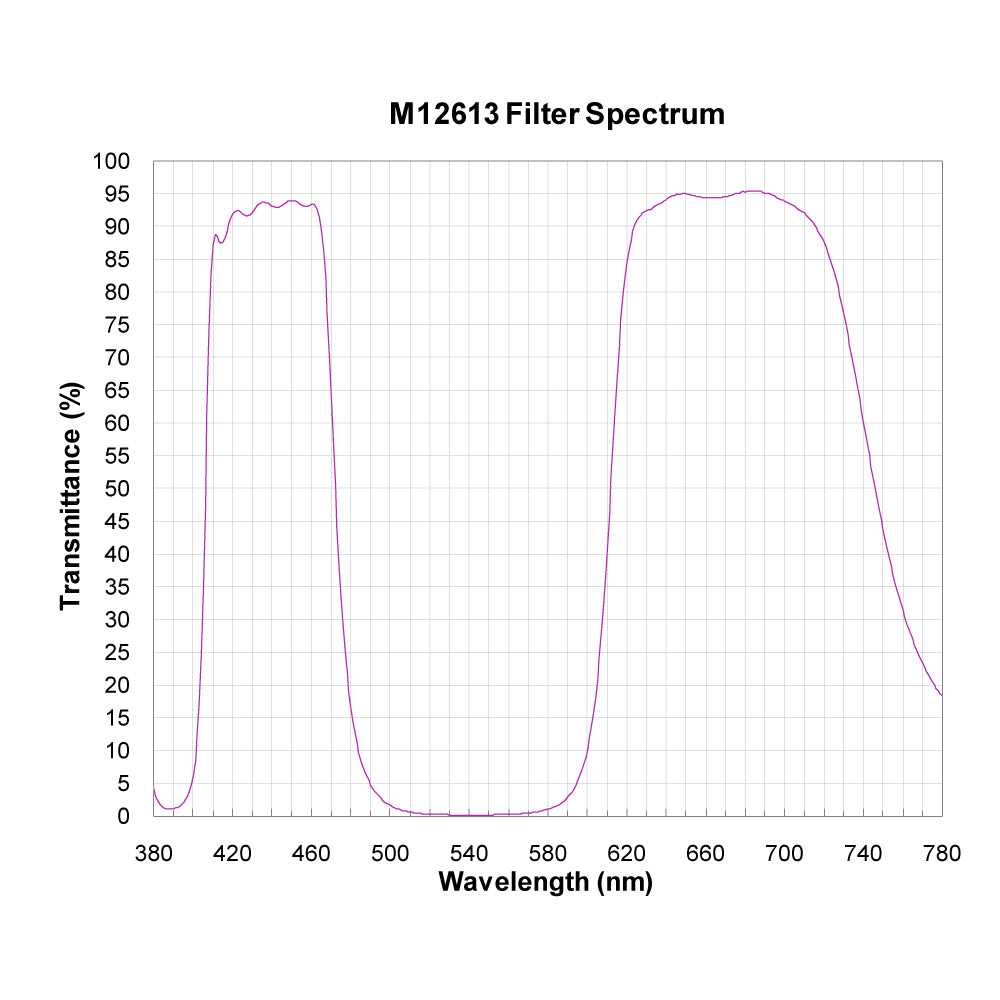
472-612 nm nominal rejection-region broadband notch filter (M12613)
M12613 is a broadband notch filter. Its measured curve has a low-transmission region at approximately 490-594 nm, with transmission recovering on either side. Choose it for broad spectral suppression rather than assuming a narrow laser-line stop.
Optical performance
- Measured wavelength range: 380-780 nm. Performance outside this measured interval is not established by this curve.
- Selected regions at or above 80% transmission: 409-467 nm; 619-727 nm. Approximate measured intervals.
- Selected regions at or below 5% transmission: 380-399 nm; 490-594 nm. Measured sample intervals; confirm the required blocking for your order.
- Peak transmission: Approximately 95.5% at 682 nm. Peak wavelength is not the same as a defined centre wavelength.
- Measured edge at 50% transmission: Approximately 472.1 nm. Interpolated absolute-transmission crossing, checked against the factory summary.
- Measured edge at 50% transmission: Approximately 611.7 nm. Interpolated absolute-transmission crossing, checked against the factory summary.
- Customization: We can customize stock and sample-book designs. Tell us the wavelength response, size and operating conditions you need.
These values come from the measured samples and help you choose a starting design. We will agree the final specification for your order. Custom versions have their own specifications and measured curves.
Applications to consider
- Broadband illumination shaping: Consider suppressing the indicated wavelength region while retaining shorter and longer wavelengths. Check that the desired signal lies outside the transition bands.
- Spectral contrast development: Evaluate whether reducing the rejected band improves contrast for a selected source and detector. Compare both remaining transmission regions with detector sensitivity.
- Multi-region optical experiments: Consider retaining light on both sides of the rejection band. Add channel-separation optics if independent measurements are required.
Choosing this filter
- Additional regions reach at least 50% transmission at approximately 407-472 nm. Include these in the detector and blocking assessment.
- Check the full wavelength range of your light source, the wavelengths your detector responds to, and how much unwanted light you need to block. Use the full curve when choosing a filter; the product code and peak do not tell the whole story.
- Tell us the angle at which light reaches the filter and whether the beam is parallel or converging. For demanding rejection or high-power use, confirm the required blocking and power-handling specifications.
Custom options
Start with this stock or sample-book design, then tell us what you need to change. We can discuss the wavelength bands, transmission, blocking, angle, glass material, size and operating conditions with you, and agree a specification for your custom filter.
Transmission spectrum
Questions about M12613
Which part of the spectrum is most useful when choosing M12613?
The measured regions at or above 80% transmission are 409-467 nm; 619-727 nm. They are measured intervals, not guaranteed passband tolerances. Compare the full curve with the signal wavelengths you need to retain.
What should I check beyond the main transmission region of M12613?
For M12613, additional regions reach at least 50% transmission at approximately 407-472 nm. If your detector responds there, include that light in the background assessment or discuss an additional blocking requirement.
Discuss this filter with KUPO - include the product reference, source wavelength, working angle and required dimensions.